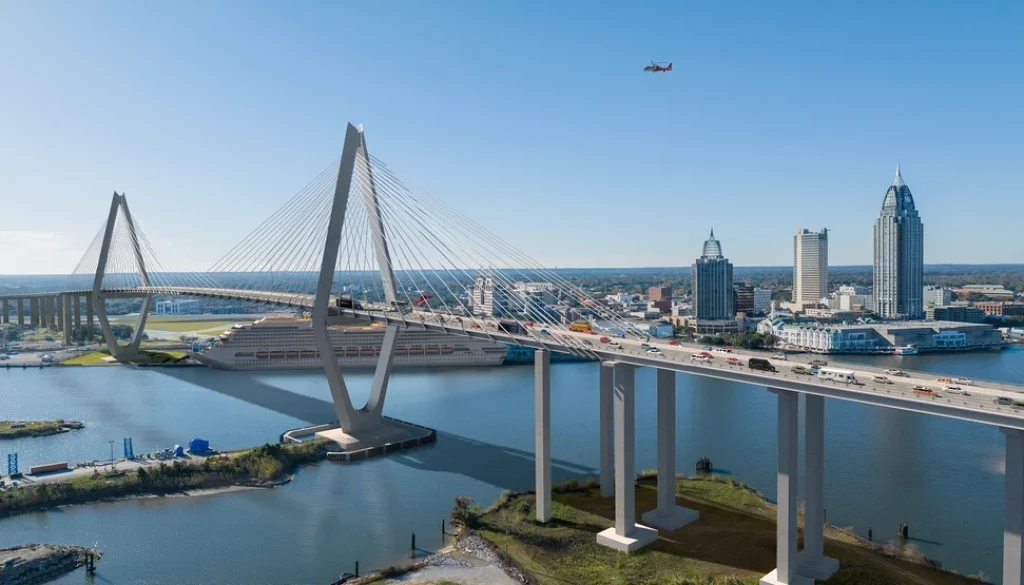
Mobile River Bridge Slowly Moving Forward As Costs Steadily Climb
By Rick McCann
Blue RAM Media/Gulf Coast News
July 11, 2026
MOBILE, Ala. The Mobile River Bridge is on again and off again and with every delay, the cost of building the bridge is increasing.
A revised plan recently announced by ALDOT, the Mobile Metropolitan Planning Organization and the Eastern Shore Metropolitan Planning Organization would begin with construction of a new six-lane cable-stayed bridge over the Mobile River, interchange improvements and restriping the existing Bayway to create six lanes across Mobile Bay.
ALDOT now says that the construction could take at least five years to complete and that the construction of a new Bayway, which was once a central part of the project, would be pushed into a second phase.
ALDOT admits that there’s a lot of moving parts, and that delays are costing the construction price tag to increase significantly.
A representative now states that Phase One includes “utilizing the existing good condition of the Bayway by restriping it to provide six lanes of capacity across Mobile Bay.” Phase Two is described only as “construction of a new Bayway structure, to be paid for by toll revenue under existing toll rates.”
The cost of the tolls could not reach $8.00 per crossing and that’s if everything falls into place during the new timeline.
ALDOT says the revised approach is necessary to keep the project alive.
“To reduce costs and maintain a viable path forward, ALDOT is moving forward with a phased project approach,” the fact sheet states.
ALDOT admits that the cost of the construction continues to grow compared to the cost estimate issued in 2019, when the Mobile River Bridge and Bayway project was widely described as a roughly $2.1 billion project, with proposed tolls of $6 one way or a $90 monthly pass.
By 2022, ALDOT said inflation had pushed the project’s construction estimate from $2.1 billion to $2.7 billion. That revived framework called for a new Mobile River Bridge and a new Bayway, with free routes preserved, passenger vehicle tolls of $2.50 or less, and a $40 monthly unlimited pass.
The latest fact sheet lists Phase One construction costs alone at approximately $3.2 billion.
That number does not include a current public estimate for Phase Two construction of the new Bayway. ALDOT’s 2024 project budget previously listed the Bayway and east-side interchange work at about $960 million in 2023 dollars, separate from the $1.345 billion listed for the Mobile River Bridge and west-side interchange work.
“Over the past five years, the Mobile River Bridge and Bayway Project has faced significant financial and engineering challenges,” the fact sheet says, citing “significant nationwide construction inflation,” “major increases in labor and material costs,” “unexpected geotechnical and engineering challenges on the Bayway” and “costly federal regulatory requirements.”
The new plan also comes with higher tolls than the framework local leaders endorsed in 2022.
The earlier plan called for a $40 monthly unlimited commuter pass and passenger tolls of $2.50 or less with an ALGO pass.
The new plan calls for a $60 unlimited monthly commuter pass, a $3 per-trip ALGO Pass rate, and $7.70 for users with interoperable transponders. Drivers without a transponder would be billed through a pay-by-plate process, though the exact pay-by-plate rate was not listed in the release.
“No tolls would be collected until the new bridge opens, currently projected around 2031,” ALDOT said in the release. Existing free routes, including the Wallace Tunnel, Bankhead Tunnel, Causeway and Africatown Bridge, would remain open and would not be tolled.
ALDOT says the toll rates are designed to keep costs reasonable for frequent users and remain “well below current and anticipated inflation rates since the new toll structure was first announced in 2021.”
Governor Kay Ivey’s office has repeatedly stood by the project stating that it is essential for Alabama’s future and represents one of the most important infrastructure investments in our state’s history.
“This transformative project will strengthen our economy, improve safety and ensure we are better prepared in times of emergency.”
Business leaders both in Southern Alabama and statewide have called for the construction to begin immediately and to reduce the cost through grants and additional federal spending.
U.S. Sen. Tommy Tuberville credited the Trump Administration with “cutting through the red tape” and said the project is critical for commerce, travel, hurricane evacuations and national security.
U.S. Sen. Katie Britt called it “exactly the kind of strategic infrastructure investment that strengthens our economy, supports our port, improves safety, and benefits every American who travels the I-10 corridor.”
ALDOT says the project is positioned to break ground before the end of 2026, pending approval of a federal TIFIA loan. Phase One completion is expected in 2031.
Copyright 2026 Blue RAM Media. All rights reserved.
SUPPORT OUR “LOCAL” NEWS
https://bluerammedia.com/DONATE/